You can't see it. You can't smell it. You won't feel it on your skin. And in twenty years' time it kills you. Respirable crystalline silica is the dust thrown up every time someone cuts a block, drills concrete, chases a wall, or sweeps up after the brickie. HSE prosecutes for it. Operatives end up on oxygen for it. This talk is the script a supervisor needs to brief the team on what silica is, why it matters, and the controls that actually stop it.
Why it matters
HSE calls silica one of the Big 3 construction killers, alongside asbestos and noise. The Workplace Exposure Limit is 0.1 mg/m³ over 8 hours. Invisible at that level. Around 500 UK construction workers a year die from silica-related lung disease. There is no cure for silicosis. The Control of Substances Hazardous to Health Regulations 2002 (COSHH) require us to control exposure at source, not just hand out masks.
PPE for this task
Hard hat
Hi-vis vest
Safety boots
FFP3 disposable mask or P3 reusable half-mask (face fit tested, clean-shaven)
Safety glasses or goggles
Gloves with grip
The hierarchy of control for dust
RPE is the last line, not the first. Engineering controls (water suppression, on-tool extraction) sit above PPE on every COSHH assessment for a reason.
What to say
Spoken script for the supervisor. Read or paraphrase, in order.
What silica actually is, and why it kills slowly
Silica is the crystal in stone, concrete, brick, mortar, tiles, sand and most blocks. When you cut, drill, grind or break those materials, you release respirable particles. Small enough to bypass your nose, your throat, your bronchi, and lodge in the deep tissue of your lungs. Your body can't shift them. Over years, scarring builds up. That's silicosis. It's irreversible, it shortens your life by 10 to 30 years, and the symptoms don't show until the damage is already done. The dust you can see is the warning. The dust that kills you is the dust you can't see.
The hierarchy: what we try before handing out masks
RPE is the last line, not the first. The Work-related Lung Disease prosecutions HSE wins are usually about employers who jumped straight to handing out a paper mask and called the job done. The order is: first, avoid creating the dust at all. Pre-cut materials off site, use blocks of the right size, buy in pre-mixed instead of mixing on site. If you can't avoid it, suppress at source. Water on the cut, on-tool extraction connected to an H-class vacuum. If you still can't get exposure down, reduce time and people exposed. Rotate the team, set up exclusion zones, do it when fewer people are around. Last, and only last, is RPE.
Water and on-tool extraction: the controls that actually work
Cut wet wherever you can. Water suppression cuts dust by 90% or more. Disc cutters, floor saws, wall chasers, chop saws are all available with water feed. Yes, it's messier. Yes, it freezes in winter. Do it anyway. Where wet cutting isn't possible, use on-tool extraction connected to an M-class or H-class vacuum. Not a workshop vac, not a domestic hoover. The filter rating matters. An H-class will hold respirable dust; an L-class lets it straight back into your face.
FFP3, face fit, and clean-shaven
For silica, the minimum is FFP3 disposable or a P3 reusable half-mask. FFP2 doesn't cut it for silica. A paper dust mask from the supermarket doesn't even pretend to. The mask only works if it seals to your face. That means face fit testing. The employer's responsibility, done by a competent fit tester, recorded, and re-done if you lose or gain weight or change mask model. And clean-shaven on the day. A two-day stubble breaks the seal. That's not me being awkward. It's the law and it's what the FFP3 mark assumes.
Housekeeping: the bit everyone gets wrong
Don't sweep dry. Dry sweeping kicks back into the air the same dust you just stopped someone breathing. Use the H-class vacuum or wet-wipe. Don't blast it down with the compressor. Same problem, faster. Bag waste while it's still damp where you can. And the changing area: don't take dust-covered clothes home. Brush off outside or change before getting in the van. Silica on your jumper goes to your kids when you hug them.
Health surveillance: what we have to do, what you have to do
If you're regularly exposed to silica, your employer has to provide health surveillance. That's a lung-function test (spirometry) baseline and then annually. Symptoms questionnaire. Sometimes a chest X-ray. If you've ever cut blocks regularly without proper controls and you've never had a lung test arranged through work, tell us today. And on your side: any cough that's hung around longer than three weeks, any breathlessness on stairs that's new, any unexplained tiredness. That's a GP conversation. Don't sit on it.
Silica dust controls in order
The hazard, the control that works, and the mask you wear when neither of the others can fully eliminate it
The hazard
Respirable crystalline silica, invisible at the WEL
Engineering control
On-tool extraction, H-class vacuum, water suppression
RPE: last line
FFP3 face-fit tested, clean-shaven (only after the controls above)
Common mistakes to call out
Cutting blocks dry on site when wet cutting was available
Using a workshop vac (L-class) for on-tool extraction instead of an M or H-class
Wearing a P3 mask over stubble, sideburns, or a beard (breaks the face seal completely)
Re-using a disposable FFP3 across multiple shifts (single-shift, single-task only)
Treating a paper dust mask as the same thing as an FFP3 (it isn't, not even close)
Dry sweeping at the end of the day (puts back into the air what the controls just removed)
Blowing down with compressed air to "clean" the work area
Taking dust-laden overalls home in the van without changing first
Skipping face fit testing because "this mask fit the last guy fine"
Cutting indoors with no ventilation, doors closed, no on-tool extraction
Watch on site this week
What the supervisor should be actively spotting on walk-arounds.
Anyone using a disc cutter, floor saw, wall chaser or chop saw dry, with no water feed and no extraction
Vacuums on site that don't carry an M or H-class label
Bearded operatives wearing tight-fit RPE (it isn't sealing, regardless of how it looks)
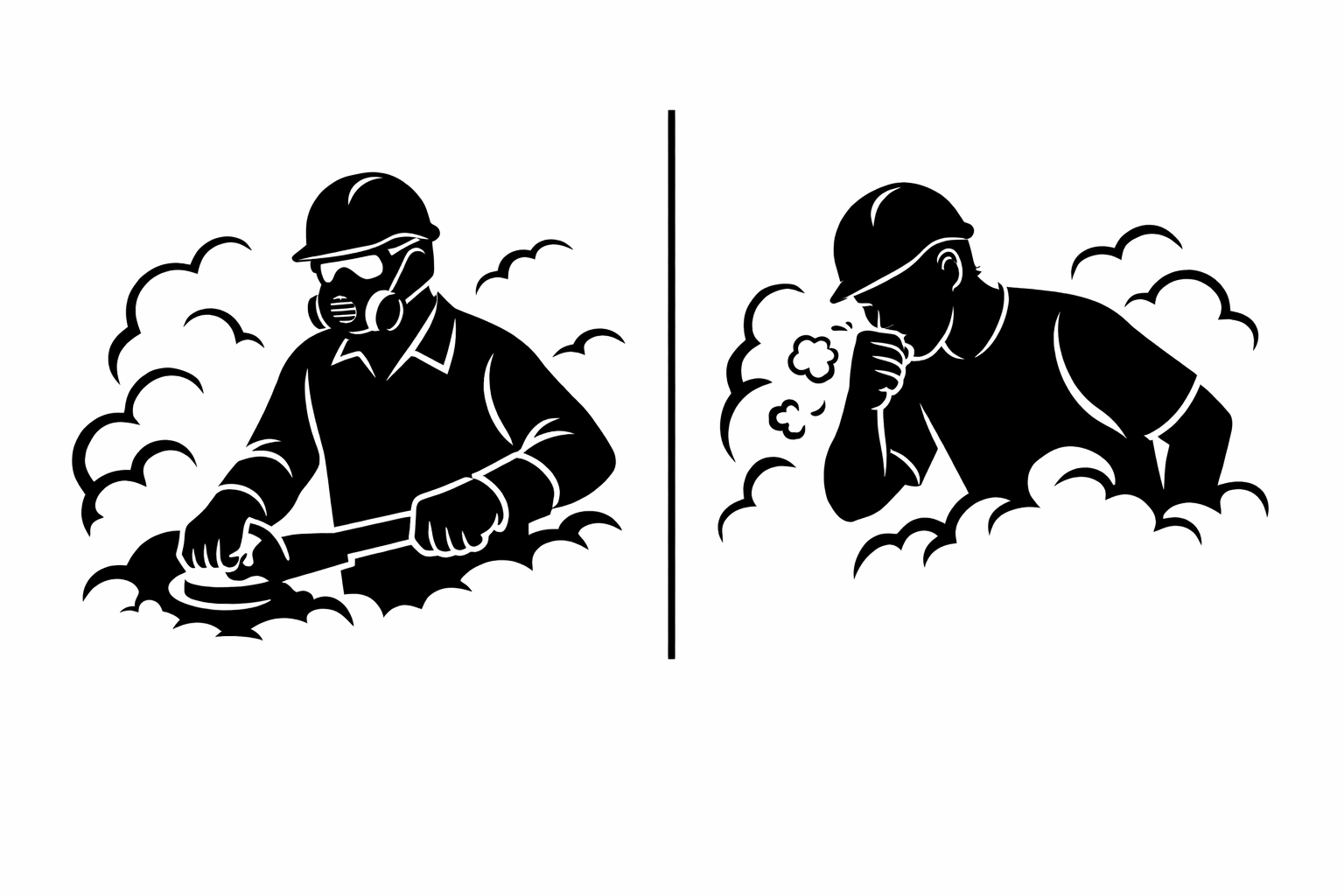
Operatives in clouds of visible dust without RPE (and the cloud you can't see is the worse one)
Sweeping with a stiff brush after cut-up, no water down first
Operatives swapping or sharing tight-fit masks (each face fit is one-mask, one-person)
FFP3 masks stored loose in toolbox or van (they need to be clean and undamaged before use)
Cutting bays in confined or partially enclosed spaces without forced extraction
Empty water tanks on water-suppressed saws (operatives cutting "just one quick one" dry)
Operatives blowing dust off PPE or off their boots with compressed air
Confirm the team understood
Ask one or two of these at the end. Confirms attention more than a silent nod.
What's the Workplace Exposure Limit for respirable crystalline silica over 8 hours? (0.1 mg/m³, and you can't see dust at that level.)
What's the minimum RPE rating for silica? (FFP3 disposable or P3 reusable. Not FFP2, not a paper mask.)
Why can't you wear a tight-fit mask with stubble or a beard? (It breaks the face seal, the mask stops working.)
Where on this site are the H-class vacuum and the water-suppressed saw kept, and who checks them daily?
Need site-specific RAMS for the job this talk is about?
A toolbox talk is generic by design. It works on every site. Your RAMS isn't. Briefkit writes a site-specific RAMS for your actual job: the hazards, sequence, PPE, competencies and emergency arrangements that apply to this work, at this address, by this team. £30 per document.