A ready-to-deliver toolbox talk for foremen and supervisors. 8-10 minute spoken script plus briefing register for operative sign-in.
Plant kills more construction workers than almost anything else on site. Not because the operators are bad, but because the moment a person on foot ends up in the wrong space, the maths is brutal. A 14-tonne excavator slewing doesn't know you're there. A dumper reversing has a blind spot wider than a transit van. A telehandler tipping crushes whoever's underneath. This talk is about keeping the two apart on purpose, every shift, every site.
Why it matters
Around 30-40 UK construction workers a year are killed by being struck by a moving vehicle or piece of plant. Another several hundred suffer life-changing injuries. The HSE consistently identifies poor segregation between people on foot and moving plant as the single biggest factor. CDM 2015 puts the duty on the principal contractor to plan and maintain pedestrian and vehicle routes that don't cross. PUWER 1998 puts the duty on the employer of the operator to make sure the plant is safe to use, including the controls around it.
Spoken script for the supervisor. Read or paraphrase, in order.
The hierarchy: eliminate, segregate, control
First we try to eliminate the conflict entirely. Can the work be done when plant isn't operating? Can the plant be parked while the foot work happens? Often yes, if we plan it. If we can't eliminate, we segregate physically: barriers, fences, routed walkways that don't cross the plant area. If we can't segregate physically, we control with admin: banksmen, signage, exclusion zones, agreed signals, radio contact. Each step is worse than the one before. PPE is the last line and on its own it's not segregation, it's just visibility.
Exclusion zones: how big and how marked
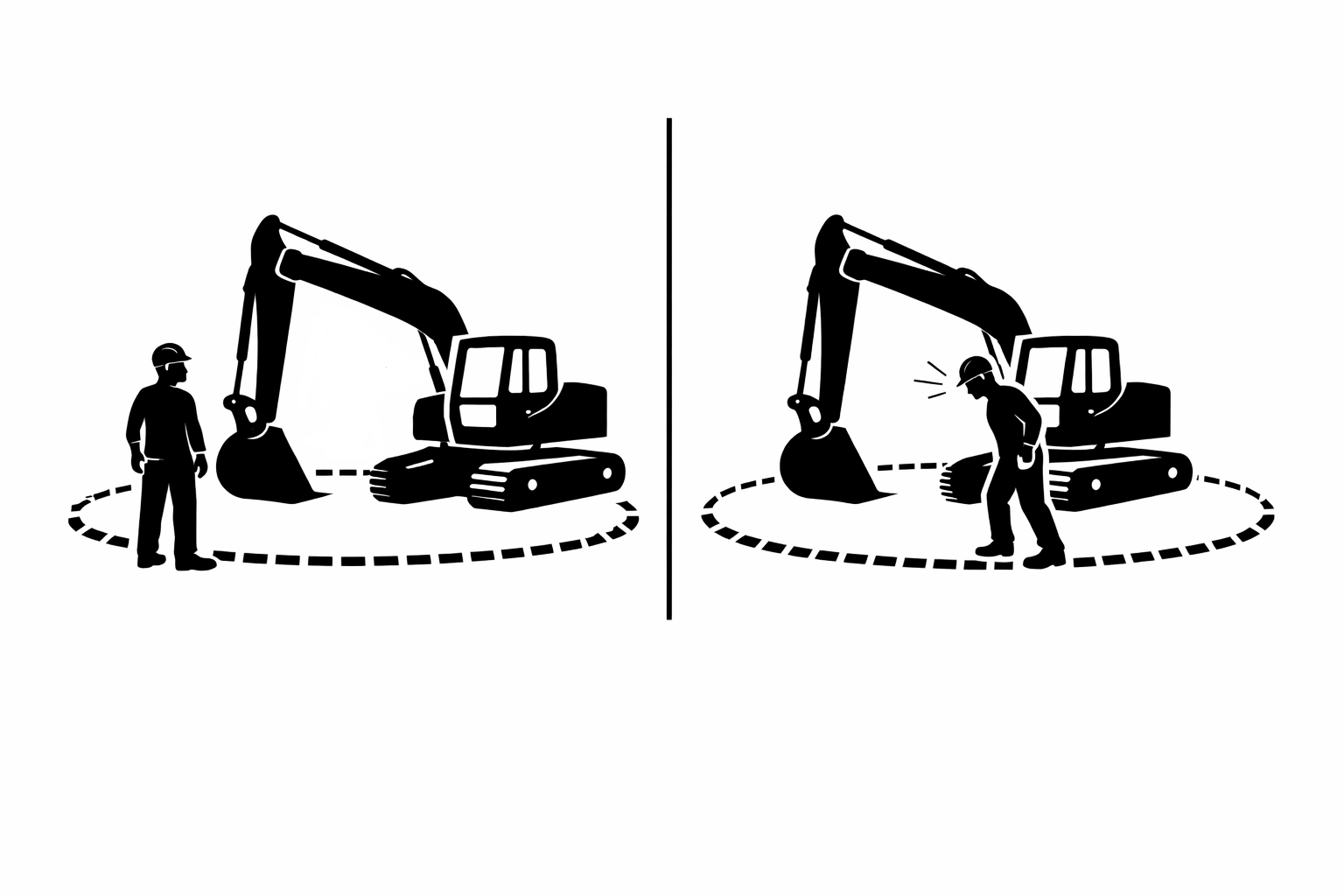
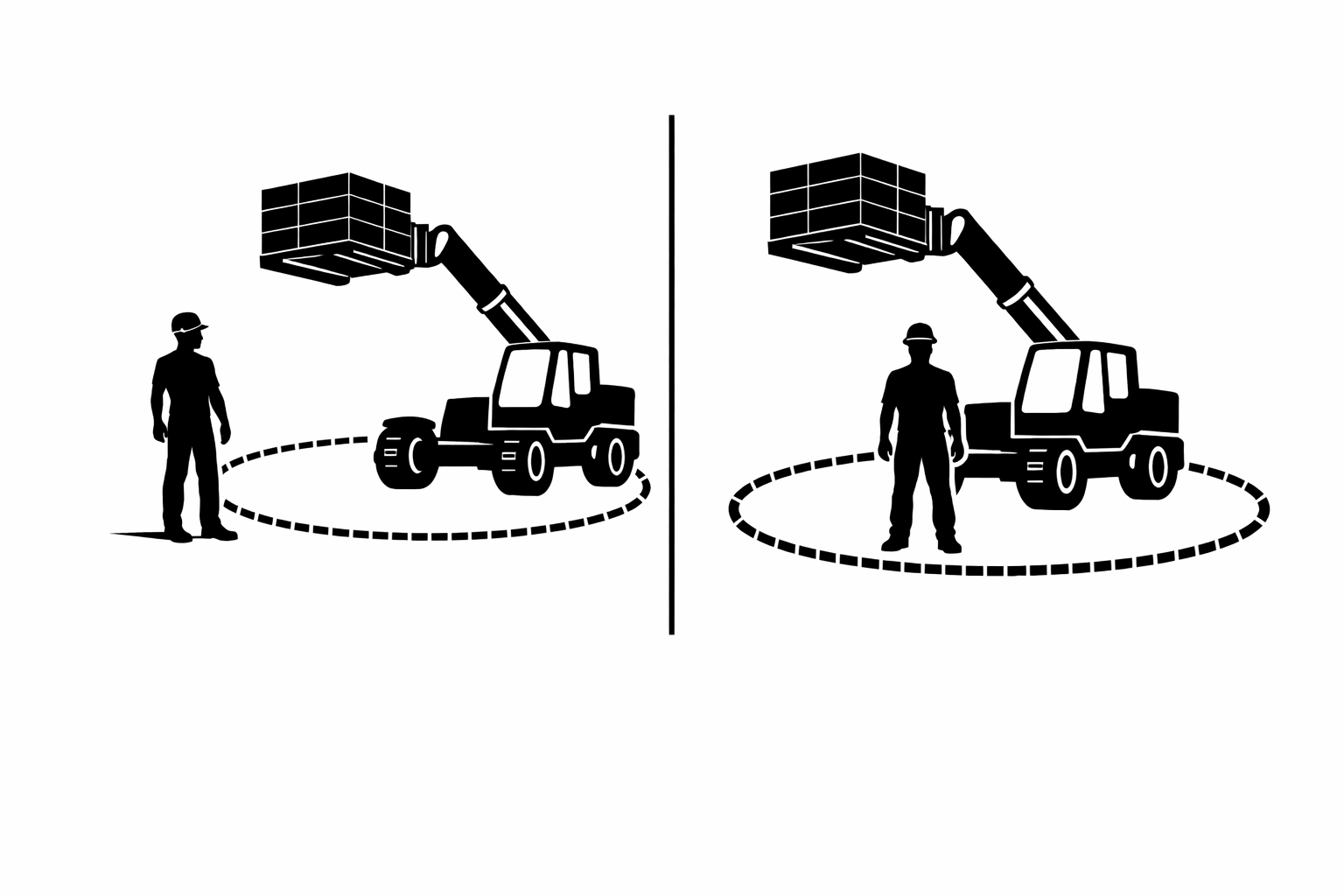
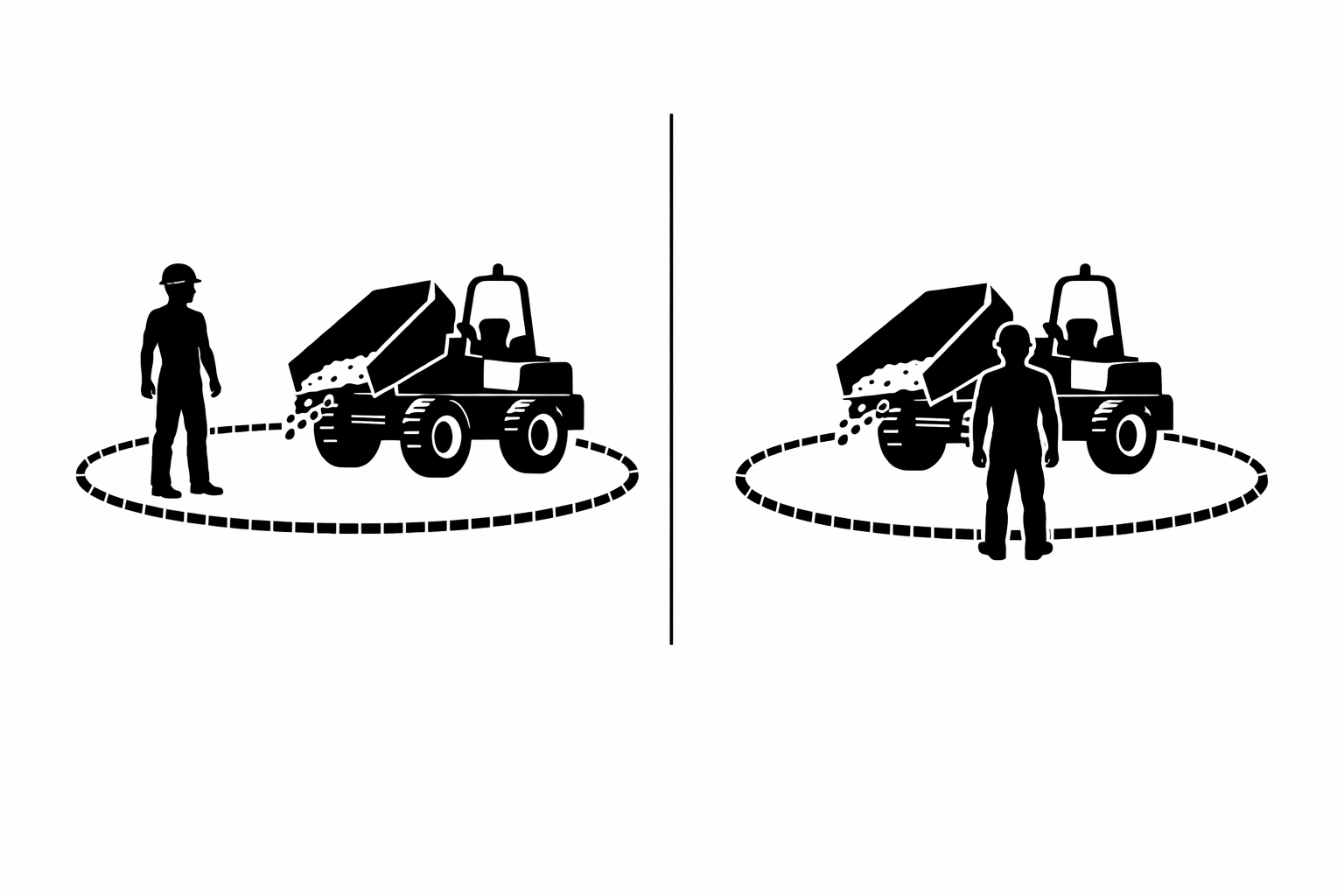
Around any operating plant there's an exclusion zone nobody on foot enters without permission. The size depends on the machine and the task. For a tracked excavator, the rule of thumb is the full slewing radius plus 2 metres (so for a 20-tonne machine that's 7-9 metres in every direction). For a telehandler with a load up, it's the full reach of the boom in any direction the load can travel, plus a fall margin. For a dumper, it's at least 5 metres behind the vehicle and across the full discharge arc when tipping. Mark the zones with cones, tape, Heras, or chapter 8 barriers. Operatives know not to cross without making eye contact with the operator and getting a thumbs-up.
The excavator hazards: tail swing and blind spots
An excavator's counterweight swings out the back when the cab turns. The operator can see the bucket, can usually see the cab side, often cannot see the tail. A worker stood behind the machine thinking they're "out of the way" is exactly in the tail-swing path. This kills people regularly. Other excavator hazards: quick hitch failures (buckets falling off when not pinned correctly), tracks running over feet when the machine repositions, and digging into buried services without scanning. Pre-start checks every shift: quick hitch pin home, tracks clear, area cleared, banksman briefed.
The telehandler hazards: tipping and load fall
Telehandlers tip. They tip sideways on slopes. They tip forwards when overloaded or with the boom extended too far. They tip when the operator turns with the load high. When they tip, the load comes off and goes wherever physics takes it. Operatives within reach of where the load could land are in the kill zone. Specific rules: stabilisers out for any lift over a metre or any extension of the boom; load capacity respected (read the chart in the cab); slope angle below the manufacturer's stated maximum; nobody under or behind the load while it's elevated; load lowered before any travel except very short repositioning. NPORS or CPCS A21 ticket for the operator, no exceptions.
The dumper hazards: reversing and end-tipping
Dumpers have killed more construction workers in recent years than any other single piece of plant. Two main reasons. Reversing: the driver's view behind is almost nothing, and white-noise alarms get tuned out on noisy sites. Solution is reverse-parking on arrival (forward-out for exit), banksman for any non-trivial reversing manoeuvre, cyclic camera checks, and physical segregation of the route. End-tipping (forward-tipping dumpers): if the ground in front of the tip point is soft, or the dumper isn't square to it, the dumper can pitch forward and crush the driver against the steering wheel. Solution is firm level ground at the tip point, never tip uphill on a slope, drive at sensible speed always with the cab belt fastened.
Banksmen: when and how
A banksman is required whenever the operator can't see the area they're moving into, or whenever pedestrians could be present. That covers basically every reversing manoeuvre on a busy site. The banksman stands where the operator can see them in the mirror at all times. Standard signals: arms crossed for stop, palm patting downward for slow, beckoning for come back. Banksman authorised to stop the movement instantly if anything goes wrong. Banksman is not optional and is not a chargeable extra for the foreman to skip. NRSWA training where the work is on or near the highway.
Communication and the agreed signal
Before any operative crosses an exclusion zone, two-way signal: pedestrian makes eye contact with operator and waits for the operator to acknowledge (thumbs up, machine paused, bucket lowered). Operator does not assume the operative will get out of the way. Radio handsets on busy sites, especially around lifting operations. If the operative is wearing hearing protection or hi-vis is dirty, the signal protocol is the only thing keeping them alive.
If you see plant and people too close, stop work
Anyone on site has authority to stop work the moment plant and pedestrians look too close. That's not a recommendation, it's a duty. If you see a worker drift into an exclusion zone, blow your whistle, raise your hand, shout, do whatever stops the operation. The conversation afterwards about whether you over-reacted is fine. The conversation that doesn't happen is the one where the bag goes in the body wagon.
What the supervisor should be actively spotting on walk-arounds.
Ask one or two of these at the end. Confirms attention more than a silent nod.
Need site-specific RAMS for the job this talk is about?
A toolbox talk is generic by design. It works on every site. Your RAMS isn't. Briefkit writes a site-specific RAMS for your actual job: the hazards, sequence, PPE, competencies and emergency arrangements that apply to this work, at this address, by this team. £30 per document.
Order a RAMS for £30 →